
Field notes / AI systems
Where You Actually Are With AI: The Five Levels, and Why Most Operators Are at Two
Most operators think they are at level four. They are at level two. Here is the ladder, the test that tells you where you actually sit, and what it costs to move up a rung.
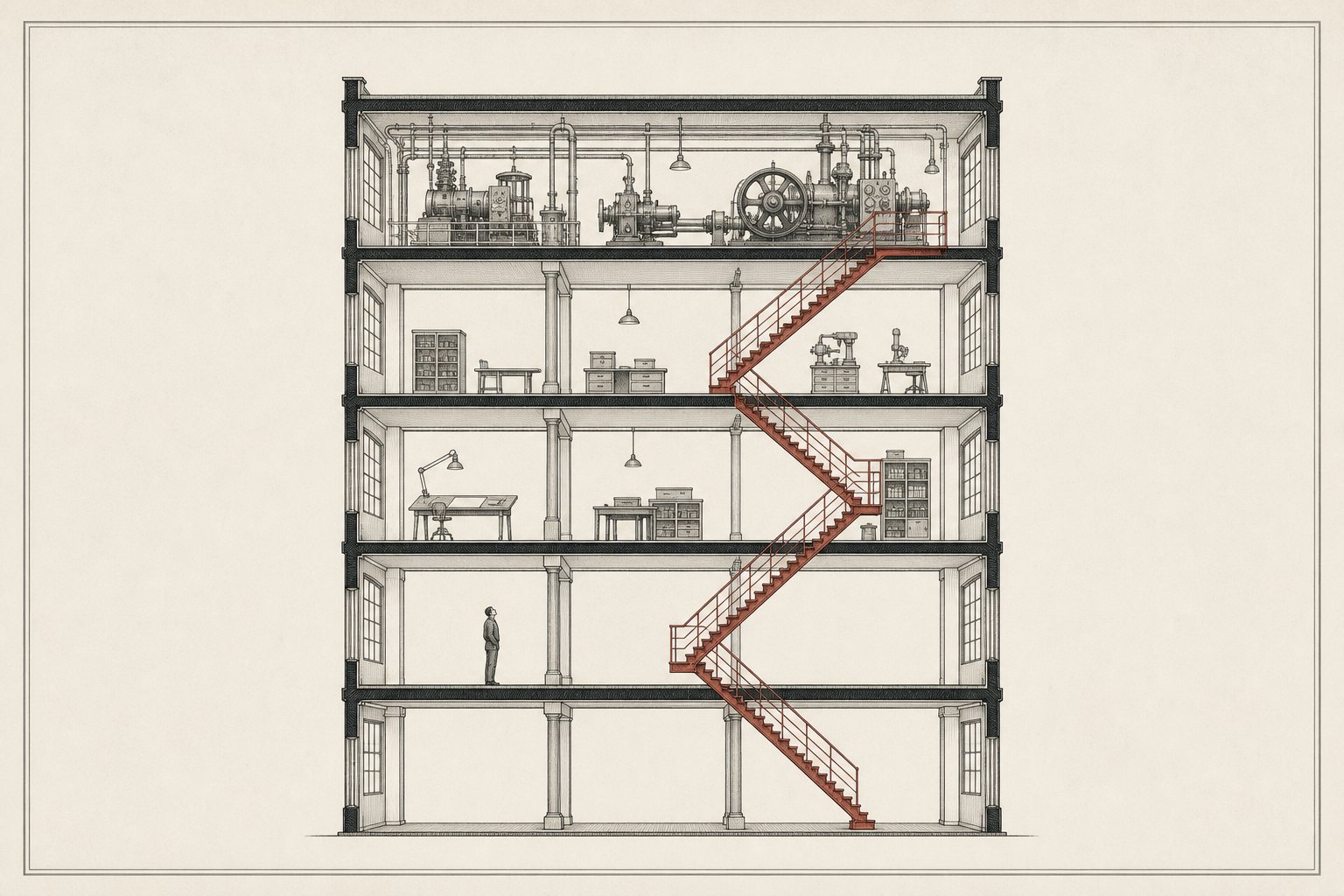
Every conversation I have about AI in a real estate business starts in the same wrong place: which tool is best. ChatGPT or Claude. Zapier or n8n. Someone in the group chat swears by a new one every week.
That question does not matter much, and here is why. Two operators can run the exact same model, with the exact same prompt, and get results that are not remotely comparable as businesses. One of them has a habit. The other one has an asset.
The thing that separates them is not intelligence. It is who the runtime is. At the bottom of the ladder, you are the runtime. Nothing happens unless you sit down and type. At the top, the business is the runtime. The work happens on a trigger, someone gets told when it breaks, and you could hand the whole thing to a new hire without a two-hour walkthrough.
The test
You go dark for two weeks. Phone off, laptop closed, actually off.
Which of your AI work still happens while you are gone? And if it stops, who finds out, and how long does it take them?
Your honest answer is your level. Almost everyone scores lower than they expect.
-
Survives you: no
The chat window
You open a browser tab, paste something in, read the answer, paste it back out. A seller's rambling email becomes three clear bullet points. A 40-page PSA becomes a list of the things that could hurt you. A rent roll you did not build becomes something you can talk about on a call in ten minutes.
This is not nothing. For an operator who has never done it, level 1 is the biggest single jump on the whole ladder, and it costs twenty dollars a month. Most people underuse it badly. They ask it four-word questions and conclude the technology is overhyped.
The ceiling is that nothing persists. You re-explain your buy box every single time. The quality of what you get back swings with how you happened to phrase it that morning. Your VA cannot reproduce your results because your results live in your head, not in a file. And the second you stop typing, the output stops.
-
Survives you: no
Chat with memory
Now the context lives somewhere other than your brain. You have a project or a custom assistant loaded with your buy box, your LOI language, your target markets, your last twelve deals. You have prompts you saved because they worked. You stop starting from zero.
The change here is repeatability. When you paste a property into a loaded project, the answer comes back in your format, against your criteria, and it comes back the same way on Tuesday as it did on Friday. That is what makes it delegable. Your acquisitions VA can now produce something close to what you would have produced, which is the first time AI does anything for your business rather than for you personally.
The ceiling is that the trigger is still a human finger. Your Gmail does not know this exists. Your CRM does not know this exists. Every boundary between the assistant and your actual systems is crossed by a person copying and pasting, which means the whole thing runs at the speed of that person remembering to do it.
-
Survives you: no
The connected assistant
The model finally touches your real systems. It reads your inbox. It writes to your sheet. It moves a card in your CRM. You wire it up with connectors, or a Zapier or n8n scenario, or a script running on your machine.
This is where the hours come back. A concrete one: every wholesaler blast that hits your inbox gets read, checked against your buy box, and either labeled for underwriting or archived, with every property logged to a sheet so you can see what your market is actually sending you. Nobody copies anything. You open your laptop and the screening already happened.
Level 3 is also where almost everyone confuses progress with durability, and it is worth being blunt about why. That workflow runs under your personal login, on your machine or your personal account, built by you. It will break. A sender changes their email format, an API key expires, a vendor renames a field, your laptop sleeps through the trigger. And when it breaks, nothing tells you. There is no error. There is just an inbox that looks quiet.
You find out in week three, from the deal you did not see. That is the real cost, and it does not show up on any subscription line.
-
Survives you: yes
The deployed workflow
Same work as level 3. Completely different relationship to your business.
It runs on a server, on a schedule or a trigger, not on your laptop. Errors are caught and someone is told, by text or Slack, within minutes rather than weeks. Every run is logged, so when your partner asks what happened on the 14th, you can answer instead of guessing. The cost per run is a number you know. Access does not depend on your personal account, so your acquisitions person can use it and your bookkeeper can use it and neither of them has to be you.
The buy box screener from level 3, at level 4: it runs at 6am whether your laptop is open or not, posts matches to the channel your acquisitions person watches, and pings you if it fails twice in a row.
That last clause is the entire jump. Not the automation. The alerting. Level 4 is the first rung where the system tells you the truth about itself.
The remaining ceiling: you now know that it ran. You still do not systematically know that it was right.
-
Survives you: yes
The production system
Level 5 adds the two things that make a system trustworthy enough to put in front of money: quality control and cost control.
Different models for different jobs. A cheap fast model sorts a thousand emails. A stronger one handles the judgment calls. Routing by task rather than paying premium rates for everything is often the difference between a $40 monthly bill and a $900 one, doing the identical work.
Evals. This is the piece almost nobody outside of software has heard of, and it is the one that matters most. An eval is a fixed set of cases where you already know the right answer. You re-run them every time you change a prompt, and every time the vendor changes the model underneath you, which they do without asking. If quality drifts, you find out from your test set instead of from a capital partner reading a bad summary.
Around those two things: versioned prompts so you can roll back, access control so the right people see the right data, and an audit trail so you can reconstruct any decision the system made.
What you get is a system that survives the person who built it. It is on the org chart, not in someone's head. If you sold the company tomorrow, it would go with it, and that is a reasonable definition of an asset.
Most of you should stop at level 3
I build level 4 and level 5 systems, so read the next paragraph with that in mind and then check it against your own numbers.
Most operators reading this should get to level 2, then level 3, and then stop. Going higher costs real money and real setup time, and if the underlying work does not justify it, you have bought infrastructure for a hobby. The upgrade is not a maturity badge. It is a decision with four inputs.
- How often does it run? Under once a week, stay where you are. A human trigger is fine for something you do four times a month, and you will notice it did not happen.
- What does a silent failure cost? If two weeks of nothing means a missed deal, a mispriced offer, or a tenant issue nobody saw, you need level 4's alerting. If two weeks of nothing means you write a few emails yourself, you do not.
- How many people depend on it? The moment a second person relies on the output, your laptop is a single point of failure and your personal login is a permissions problem.
- Does money or a contract move? Anything that touches an offer, a wire, a lease, or what you tell a capital partner needs level 5's audit trail and evals. Not because it will be wrong often, but because you have to be able to prove what it did.
If you answered no across all four, you have a level 3 business and you should spend your energy on being genuinely excellent at level 3 instead of buying level 5. If you answered yes to two or more, you are already exposed and you have been getting away with it.
The rest of this series
This post is the map. Each level gets its own post with the actual how-to: the setup, the specific prompts, where it breaks, and how to tell when you have outgrown it. Written so that you can build it yourself. Some of you will, and that is a fine outcome.
- 01Stop asking ChatGPT four-word questions: five habits and three prompts that actually workPublished
- 02Underwrite in 48 hours: the buy box document that lets my assistant say PASS for mePublished
- 03Three inboxes, one morning digest: how I stopped missing the seller who said yesPublished
- 04It ran when I remembered and failed in silence: making an automation your team can depend onPublished
- 05How I know my AI still thinks like me (and cut the bill from $900 to $40)Published
Not sure which level you are on?
Take the vacation test. If the honest answer bothers you, book 20 minutes and we will map what you have, what breaks first, and whether it is worth fixing. No pitch if the answer is that you should stay where you are.
Want it mapped for you instead of built by hand? That is what the AI Workflow Audit is: fixed price, two weeks, one prioritized plan.
Tried this on a real deal? Email me what worked and what didn't. I read all of it.